|

|
Should
I drain my spa for winter?
Before we begin with the draining & winterizing
procedure, please pause for a moment to ponder the
question... After all, you bought your spa for relaxation
and enjoyment, so why not use it year 'round? Many
families actually prefer to use a hot tub when weather is
the coldest. On a chilly winter's night when
toes are numb, nothing beats a hot soak in the tub! If
there's snow on the ground, it can only add to the
pleasure.. as the steam rolls off the warm water onto the
white blanket below.
There are practical concerns as well. While a properly
drained spa will save you money on energy costs and
supplies, most spa damage in cold climates is actually
caused by freeze damage due to improper
draining/winterizing (or none at all!)
| Residual
water after draining may cause damage far exceeding any savings
realized in closing the spa. And don't forget,
besides the chore of draining & closing, there
will be the same chore in reverse come spring. |
 |
If you
decide to run all year long, then be sure to read
Winter
Use below.
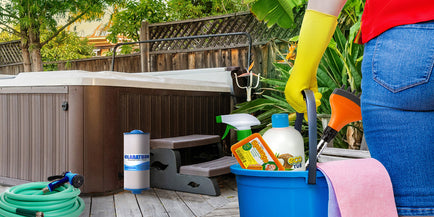
Draining for Winter
If you're still reading, then you are at
least still considering draining & winterizing your
spa or hot tub, so let's see how it is done right!
| NOTE:
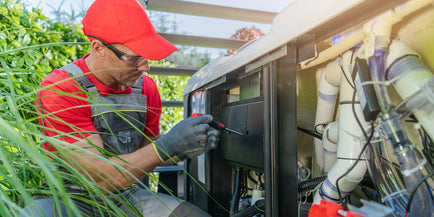
If you don't feel comfortable closing down and
winterizing a spa yourself, you may wish to contract
a local professional to do the job for you.
Remember, a good service company should guarantee
their work against freeze damage. If they don't,
pick a different company. Also note, the following
procedures are primarily for above-ground spas and
hot tubs. In-ground installations are a different
breed, and their systems are often better left to
the pros for winter service. |
-
Cut
the power
 |
Always start any
service procedure by shutting off the heater
and then powering off the spa. Then switch off the
power service at the breaker panel or disconnect
box for safety. |
Tip: Before disconnecting
power, now is a good time to check the GFCI to make
sure it is functioning properly by pressing its
"test" button.
-
Flush
your system, then drain your spa
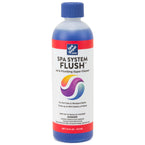
We recommend that you flush your plumbing system with Spa
System Flush. Then with cover still
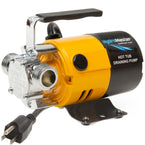
off, empty your water by opening the drain valve. Some
spas allow you to hook up a garden hose to carry the
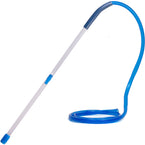
water away. A spa vac such as the Shake-a-Vac
or a submersible pump may also be used to speed the
draining and to remove remaining water and debris from
foot wells.
-
Air
blower?
If your spa is equipped with an air blower, you should
purge it of water as well. This can be done by first
shutting the heater off to prevent damage, and then
with cover back in place and power restored, running
the blower for 15 to 30 seconds. When complete, trip
the GFCI again, shut off the spa circuit at your
breaker panel, and unplug your spa as before.
Obviously if you have no blower, you can skip this
step!
-
Remove
your filters
With cover off, remove your filter(s). Now is a good
time to clean and soak them in filter cleaning
solution, so that they can be put away in a dry
location for the winter. If they've had a year or more
of use, they should be replaced with new Clarathon
Premium Spa Filters. Never store a dirty
filter. Make sure to remove any remaining water from
filter compartment-- terry towels are often helpful
here. Clean the filter compartment, and skimmer basket
if so equipped. If your spa has a separate filter
canister, make sure it is completely drained.
-
Loosen
fittings
There may be several fittings on your spa's plumbing
system that can be loosened enough to allow water to
drain. Open any unions on the inlet and outlet of your
pumps and heater. Your pump housing may have drain
plugs. These should also be opened as pumps can easily
be damaged when water freezes.
If you have an external gas heater, shut it down per
the manufacturer's instructions. Your main concern now
will be to remove all water from the unit by opening
drain valves, pipe fittings, and by blowing out
remaining water with a GFCI-protected wet-dry shop vac.
Gas heaters which are shut-down for the winter will
often require a cleaning or "tune up" in the
spring.
-
Blow
your jets
It is also important to get any remaining water out of
your jet plumbing.
 |
This
can be accomplished by first opening all jets
(with topside jet controls set to the off
position) and with your wet-dry vac set to the
blowing mode, forcing air into each of your jet
fixtures. |
Work your
way around the spa clockwise, and when you have gone
all the way around, go back around counter-clockwise
and blow out each jet again. Repeat until no
significant amounts of water can be purged.
-
Clean
your shell
Cleaning your spa shell is very important, and will
make the job of opening your spa in the spring a lot
more pleasant. Use a non-foaming cleaner such as
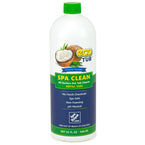
Clean
All. Wipe down all surfaces and rinse with clean
water.
-
Mop
up
Any remaining water inside the spa should now be
mopped up with terry towels. Applying spa wax or
303
Protectant to inside surfaces is a good idea, and will
make start up and cleaning of your spa in the spring
easier.
-
Protect
your cover
Clean your cover both inside and out, and apply a
quality protectant such as 303 to both inside and
outside surfaces. Never apply any product containing
silicone oil to a vinyl spa cover, as it will promote
deterioration. Replace cover, and secure & lock
the straps. If you live in a high-wind location, you
might consider the addition of additional tie-downs,
such as our
Hurricane
Straps.
-
Secure
your cabinet
If your spa has an enclosure with doors, make sure all
are closed and any thumbscrews or latches are secured.
-
Check
Wooden surrounds
If your wooden cabinet needs a coat of finish, this
should be applied before weather dampens the wood, or
the temperature gets too low.
-
Consider
a Spa Coverall
Many people cover their entire spa for the winter, if
in a location exposed to the weather. This prevents
rain water or snow melt from seeping back into the spa
and causing potential freeze damage. Far better
than hard-to-manage tarps is our
ProtectaSpa
Coverall.
-
What
about Antifreeze?
Although there are pipe antifreeze products
on the market, we do not recommend them because of the
difficulty of removing the residues in the spring.
 |
Wooden tubs
are different! |
Ideally,
wooden hot tubs should never be allowed to remain empty
for an extended period of time. As the wood dries, it will
shrink or crack, and this can cause leaks when refilled.
Any remaining moisture in the wood which is allowed to
freeze can also cause cracks.
Nevertheless,
a wooden tub can be winterized. Follow the procedures
outlined above for purging water from plumbing and
features, then leave a couple of inches of water in the
bottom. This water may freeze, but leaving it there will
help prevent shrinking and cracking of the tub bottom.
Check the tub from time to time to make sure this level is
maintained.
There may be
some shrinkage come spring, and the tub may need
re-tightening. Tarping a winterized wooden tub is usually
a good idea.
|
|

|
Winter
Use is More Fun! |
 |
Set
your controls
If on the
other hand, you decide that draining & winterizing
your spa is more trouble than it's worth, you can enjoy
your spa in the winter providing proper precautions are
taken.
First, read
and familiarize yourself with the operating instructions
that came with your spa, if you still have them. If your
spa is equipped with a freeze protection system, make sure
it is activated and that the heat settings are set
considerably higher than the bare minimum. Some spas have
a timer/auto heat mode selector. If you have one of these,
make sure it is set to the auto heat mode to protect from
freezing. If you do not have freeze protection, you can
set your timer switch to cycle on at frequent intervals.
In very cold areas, it may be necessary to cycle on at
least 15 minutes every hour. This additional run time is
important in very cold weather. Remember, if you use your
spa daily, it actually may use less energy to maintain a
constant temperature, than to let it cool down and then
heat up daily. So keep it warm, and constant.
Air
jets
 |
Running
your air jets in the winter will greatly increase
energy consumption from the injection of the cold
air into the spa water. If you do use your jets in
the winter, make certain that they are in the off
position when the spa is not in use. |
Cleaning
Since it is
not fun to drain and clean your spa in the winter, make
sure to do this chore before the weather gets miserable.
You'll be glad you did! We also recommend that you
flush your plumbing system with
Spa System Flush
to remove accumulations and buildup from the spa's
plumbing..
Worn-out covers are expensive!
A
waterlogged or deteriorated cover will cost you a
lot of money in lost energy, as it has no doubt lost
most of its insulating properties. Being heavy, it
may also be difficult to remove, may leak rain water
or snow melt into the spa, and may even collapse. If
your cover is in good condition, apply
303
Protectant. |
 |
| If
it needs replacing, do it now and save yourself from
grief later. You will pocket the energy savings all
winter long!
|
| Floating
Thermal Blanket
For energy savings, a floating thermal blanket is
a good investment. Lower heat loss by reducing
evaporation and help keep moisture buildup on
the inside of your spa cover to a minimum. |
|
|
We
recommend the closed-cell foam type. They last longer than the flimsy bubble
blankets dealers often provide with new spas.
Get the facts about our quality
ThermoFloat
spa blankets. |
Watch
the water level
Keep an eye on your spas water level, especially if you do
not use your spa every day! If your spa should lose enough
water so that the pump shuts down, the water will not
circulate, the heater will not run, and your spa could
freeze.
Monitor
your water temperature
 |
In very
cold weather, check your water temperature at least
daily to make sure the heater is functioning
properly. |
Reasonably-priced
remote digital thermometers with low-temp alarms are now
available which allow wireless monitoring of your water
temperature from inside the home. An audible alarm
can be set to alert of temperature problems.
Protect
your Cover and Woodwork
Harsh
weather-- rain, snow, wind and sun can extract
a heavy toll on any spa. The
Protecta-Spa
Coverall is inexpensive protection for your
valuable investment. You'll
rest easier knowing your cover and woodwork is
completely shielded. |
 |
|
Tip...
 |
If you like the
open feeling that an outdoor spa provides, but
would like some shelter from rain or weather,
consider a spa umbrella.
Spa
Side Umbrellas |
|
If you
lose power
 |
If you
ever lose electrical power where you live, have a
contingency plan in place. If the loss is for
a short duration, then your risk of freezing is
low. Keep the cover on tight until power is
restored. |
But in very
cold locations, with the loss of power for more than a few
hours, you will have a possibility of freeze damage-- if
you do nothing. You may wish to follow the
draining
procedures above.
If you have a
generator, you may be able to run your spa off of it to
keep the water circulating until power is restored.
If your generator is of sufficient wattage, you may even
be able to run the spa heater. If the power outage
is expected to last for an extended period of time, you
may wish to use the generator to perform the draining
operation explained in Draining for
Winter.
Energy-saving tips
|
|
|
 |
Consumer Reviews |
|
|
Tubbing in Winter
"I
just read about the winter care/prep of outdoor
tubs, and I agree with you on the winter use. I live
in Kenai Alaska, and use the tub 10 times more in
the winter than the summer. Freezing here will
probably bring on a different understanding... In
January, and February, we see temps to -30 below
zero. I have never had a freeze up problem, even in
those temps. Tubbing in the great north is second to
none! The snow, the stars, and the Northern Lights!!
Tubbing is comfortable down to around zero, but any
colder, and you ears start to get cold, and your
hair freezes solid..."
J. Kipp
Kenai, Alaska
|
|
|
|
|
|
|
REPLACEMENT PARTS
ILLUSTRATED CATALOG
|
|
For all makes & models. Common & hard to find
Spa
Parts
|
|
|
|
|
|